Last updated November 18, 2026
The Complete Home Addition Contractor Guide for Spring Valley Homeowners
Clark County issued 847 stop-work orders on residential projects in a recent 12-month span, and the pattern behind most of them was the same: a homeowner hired a contractor who never attended the county’s pre-application meeting, and the build came to a halt after the foundation was already poured. That single skipped step can cost more than a year of planning. In Spring Valley, where HOA rules layer on top of county code and summer heat pushes 115°F, the generic hiring guides don’t cover what actually goes wrong here. This guide walks you through the real permit pathway, the setback and lot-coverage numbers that differ from neighboring cities, how to read a contractor’s written scope, and what a 400 sq ft addition genuinely costs right now.
Quick Answer
A home addition in Spring Valley typically runs $95,000 to $185,000 for a 400 sq ft build, with permits, materials, and labor broken out separately on a proper written scope. The contractor you hire should be licensed in Nevada, attend the Clark County Development Services pre-application meeting with you, and give you a written price before any work begins. Skipping the pre-application meeting is the single most expensive shortcut a Spring Valley homeowner can take.
Table of Contents
- The Clark County Permit Pathway for Spring Valley Additions
- Spring Valley Setback and Lot-Coverage Rules That Differ from Henderson
- How to Read a Contractor’s Written Scope of Work
- What a 400 Sq Ft Addition Costs in Spring Valley Right Now
- The One Question That Separates Professionals from Time-Wasters
- The Spring Valley Addition Hiring Checklist
- Additions vs. ADUs: Which Fits Your Lot?
The Clark County Permit Pathway for Spring Valley Additions
Spring Valley is unincorporated Clark County, which means your permits come from Clark County Development Services, not from the city of Las Vegas. That distinction matters because the county’s process has its own queue, its own reviewers, and its own pre-application requirement that many out-of-area contractors don’t know exists.
Here is the sequence a Spring Valley addition actually follows:
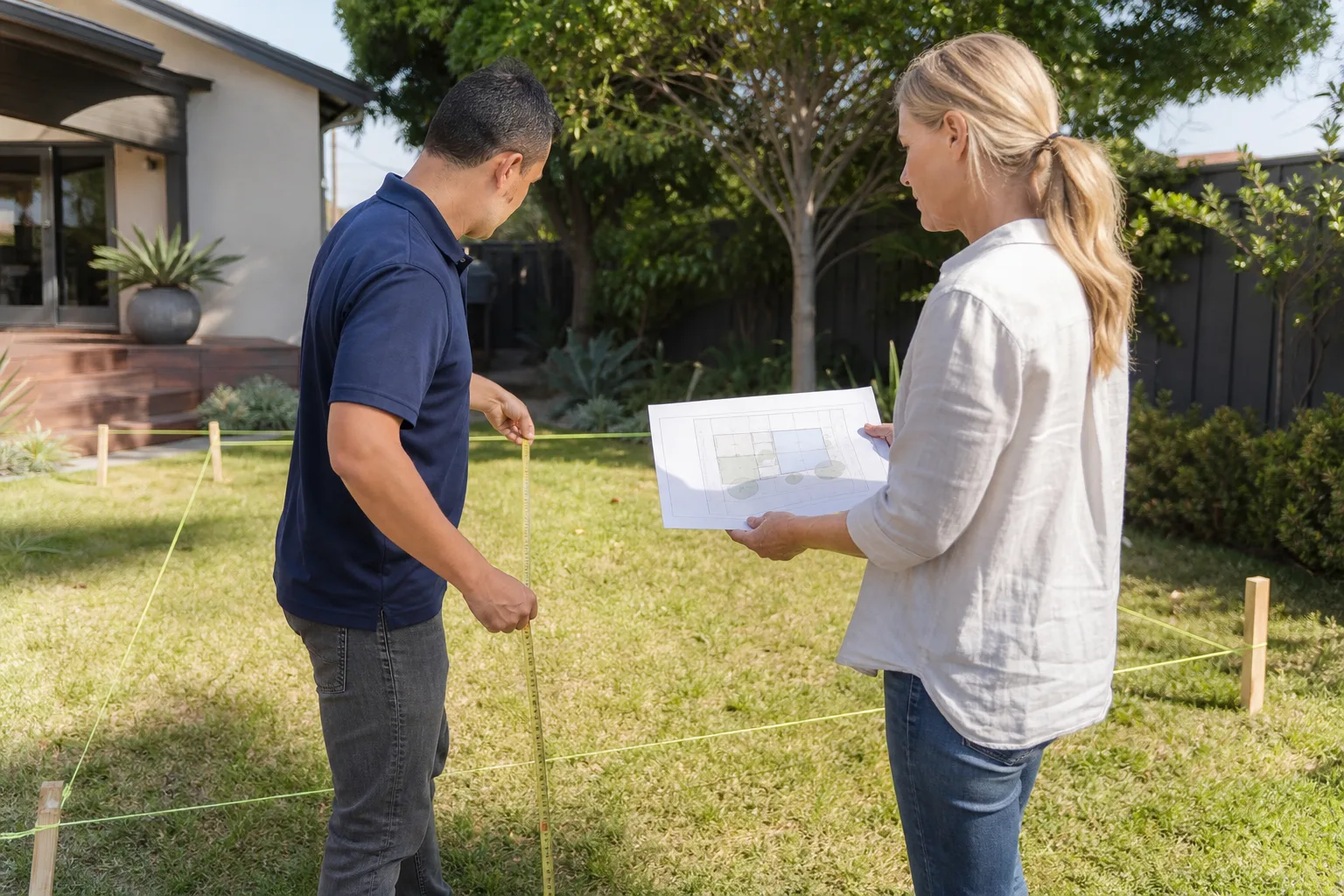
- Pre-application meeting. You and your contractor sit down with a county planner before design begins. This is where zoning, setbacks, and lot coverage get checked against your specific parcel. Skipping this meeting is where stop-work orders come from.
- Site survey and boundary verification. A licensed surveyor confirms your property lines. Older Spring Valley parcels sometimes have fences that don’t match the recorded lines, and building to a fence instead of a line is a costly error.
- Architectural and structural drawings. Stamped plans from a Nevada-licensed architect or engineer. Figure two to four weeks for this step depending on the complexity.
- Plan submittal and review. County review typically runs four to eight weeks for a residential addition, longer if the project touches grading or drainage.
- Permit issuance and inspections. Once issued, the build proceeds through a set inspection schedule. Your contractor should schedule each inspection before the work is ready, not after.
In our experience, the pre-application meeting is where a Spring Valley project either gets smooth or gets stuck. A contractor who’s done additions here will bring the parcel number, a site plan, and a list of questions to that meeting. One who hasn’t will tell you the meeting isn’t necessary. It is.
Spring Valley Setback and Lot-Coverage Rules That Differ from Henderson
One of the traps in this valley is assuming the rules are the same across every municipality. They aren’t. A contractor who builds mostly in Henderson or North Las Vegas may quote you a design that fails a Spring Valley review on the first pass.
For a single-family lot in unincorporated Clark County, the numbers to sanity-check a proposal against include:
- Front setback: commonly 20 feet from the property line for the primary structure, though corner lots and specific subdivisions can vary.
- Side setbacks: typically 5 to 10 feet depending on lot width and whether the addition has windows facing the neighbor.
- Rear setback: commonly 10 to 20 feet, tighter for detached accessory structures than for attached living space.
- Lot coverage: the combined footprint of house, garage, and any covered patios or accessory structures is capped as a percentage of the lot. Push past that cap and the county will require a variance, which adds months.
- Height limits: additions that raise the roofline above the neighborhood standard trigger additional review.
Ask your contractor to show you the specific code section they’re designing to, in writing. If they can’t point to a section, they’re guessing. Masonry walls and block fencing are common in Spring Valley subdivisions, and those existing walls sometimes sit inside the recorded setback line, which is why the survey comes before the design.
If your addition is really an accessory dwelling unit (ADU, a separate living space with its own entrance and kitchen), the rules shift again. Our guide to ADU Builders in Spring Valley covers the ADU-specific side of Clark County code in detail.
How to Read a Contractor’s Written Scope of Work
A written scope of work is the document that determines whether your project finishes on budget or turns into a series of change orders. The problem is that most homeowners have never read one closely, and most contractors write thin scopes because a thin scope protects them, not you.
Here are the four clauses most often missing, and why each one matters:
- The exclusions clause. A good scope tells you what is NOT included: landscape repair, fence relocation, appliance relocation, grading, utility tie-ins. If exclusions aren’t listed, every surprise becomes a change order with your name on it.
- The allowance clause. Windows, flooring, and fixtures are often priced as “allowances” with a placeholder number. A $3,000 window allowance sounds fine until you pick out what you actually want and the real cost is $9,000. The scope should state the allowance amount and the process for exceeding it.
- The change-order clause. It should say, in writing, how changes are priced and whether a change order requires your signature before the work proceeds. Without that, contractors can perform unapproved work and bill for it later.
- The warranty and completion clause. What’s covered after the job is done, for how long, and what triggers a return visit. At Lodgewick, every project comes with the 365-Day Done Right Promise in writing before work begins, and a free return visit if something fails within that period.
Ask for a scope that lists materials by brand and model where possible. A scope that says “tile flooring” is not the same as one that specifies James Hardie siding or a named window series. Specificity is the difference between a quote and a real number.
What a 400 Sq Ft Addition Costs in Spring Valley Right Now
Most homeowners under-budget the permit and design side and over-budget the materials side. Here’s how the numbers actually break out for a 400 sq ft single-story addition in Spring Valley.
- Architectural and engineering drawings: $4,500 to $9,000.
- Survey and boundary work: $800 to $2,200.
- Clark County permit and impact fees: $3,000 to $8,500, depending on square footage and whether the addition touches grading or utilities.
- Foundation and concrete: $14,000 to $24,000.
- Framing and rough carpentry: $18,000 to $30,000.
- Electrical, plumbing, HVAC: $12,000 to $22,000 combined.
- Insulation, drywall, and finishes: $16,000 to $28,000.
- Roofing, siding (James Hardie and similar), windows, exterior trim: $12,000 to $22,000.
- General contractor overhead and profit: typically 15 to 25 percent of the build cost.
All in, a well-scoped 400 sq ft addition in Spring Valley lands between $95,000 and $185,000. The spread reflects material choices, whether the addition shares a wall with the existing structure, and how much utility work is required. A detached structure or an ADU built from prefab components (Abodu, Cover, and Dvele are three brands we work with) can sometimes land lower on the material side but higher on site prep.
None of these numbers mean anything if the contractor won’t put them in writing. “We’ll work it out as we go” is not a price. Call (844) 780-4284 for an exact quote on your Spring Valley project. Estimates are free and the numbers are in writing before work begins.
The One Question That Separates Professionals from Time-Wasters
Before you schedule a single site visit, ask this: “Can you walk me through the Clark County pre-application process for my parcel, and which code sections govern my setbacks and lot coverage?”
A professional will answer in detail and probably ask you two or three questions back. They’ll want to know your parcel number, whether your lot is a corner, and whether there are existing easements. A time-waster will tell you the pre-application meeting isn’t required, that setbacks are “standard,” or that they’ll “figure that out at permit time.”
That single exchange tells you more than any review site or reference list. A contractor with genuine Spring Valley experience knows the code pathway well enough to explain it in plain English before seeing the lot. One who doesn’t is either going to learn it on your dime or hand the project to a subcontractor who will.
We also recommend asking whether the crew is background-checked and uniformed and how changes to the arrival window are communicated. At Lodgewick, technicians are background-checked and uniformed on every job site, and every project includes a defined arrival window in the written agreement.
The Spring Valley Addition Hiring Checklist
Use this checklist before signing a contract on any Spring Valley addition or Garage Conversion Contractor in Spring Valley project. Each item is a real failure point we’ve seen.
- Contractor holds a valid Nevada State Contractors Board license with the correct classification for residential additions.
- Certificate of insurance showing both general liability and workers’ compensation, with your property listed as a named insured for the duration of the build.
- Pre-application meeting is on the contractor’s schedule, and they’ve named a date.
- Written scope of work includes all four clauses from the previous section: exclusions, allowances, change orders, warranty.
- Written price is issued before the first nail is driven, with no verbal adjustments.
- Arrival window is defined in writing, and the contractor has explained how delays will be communicated.
- Warranty is in writing, and the length and coverage are stated clearly (our 365-Day Done Right Promise covers every project for one year from completion, with a free return visit if work fails).
- Job site clean-up standard is stated in the contract, not assumed.
If any of these items is missing or promised verbally but not written, walk away. The Home Addition Contractor in Spring Valley page covers the hire-side details in more depth, including how to verify a license through the state board.
Additions vs. ADUs: Which Fits Your Lot?
An attached addition extends your existing structure. An ADU (accessory dwelling unit, a separate living space with its own entrance, kitchen, and bathroom) sits on the same lot but functions as independent living space. A JADU (junior ADU) is smaller, typically under 500 sq ft, and shares some facilities with the main house. The trade terms matter because they change the permit path, the setback math, and what the space can legally be used for.
The name Lodgewick comes from a specific idea: a lodge is a small house on a larger property, which is exactly what an ADU is. The distinction between an addition and an ADU in Spring Valley usually comes down to three questions:
- Do you need a separate entrance and kitchen? If yes, ADU. If no, attached addition.
- Does your lot have the rear or side clearance for a detached structure? A tight lot may work better as an attached addition or a garage conversion.
- How fast do you need it? Prefab ADU construction (Abodu, Cover, Dvele, and similar) can be faster on the build side but requires the same county permit path.
For the ADU side, start at our Lodgewick ADU Builders Spring Valley home page. For garage conversions, the process looks like a small addition rather than new construction, which is why it often lands cheaper; the garage-conversion guide linked above covers that pathway.
Common Mistakes to Avoid
- Skipping the pre-application meeting. This is the mistake behind most of those 847 Clark County stop-work orders. It costs a few hundred dollars and a few hours to do it, and it saves months.
- Designing to a fence line instead of a property line. Spring Valley’s older parcels often have fences that are inside or outside the recorded line. Survey first, always.
- Accepting a verbal scope. Anything promised on a phone call or a site visit that doesn’t appear in writing doesn’t exist for the purpose of a dispute.
- Comparing quotes with different inclusions. A $95,000 quote that excludes electrical and a $130,000 quote that includes it are not the same number. Line them up line by line.
- Ignoring summer heat in the schedule. Concrete pours on 115°F days need special handling, and exterior work on west-facing walls slows down in July and August. A realistic schedule accounts for that.
- Not checking the contractor’s license classification. Residential additions require the right Nevada license class. A handyman license doesn’t cover structural work.
- Choosing on price alone. The cheapest bid is usually the one with the thinnest scope and the widest allowance gaps. It’s the change orders that move the final number.
When to Call a Professional
Call a licensed contractor when the project involves new square footage, structural changes, moving utilities, or anything requiring a county permit. That covers most additions and every ADU. It also covers garage conversions: opening a load-bearing wall, adding a bathroom, or bringing the space up to habitable-standard insulation and egress requirements is not a weekend project, and the electrical and structural side is genuinely dangerous to self-perform. The same applies to spring-tension or torsion-line systems in garage doors if the conversion touches the door opening.
Lodgewick ADU Builders Spring Valley offers free estimates in Spring Valley. Call (844) 780-4284 and we’ll put the numbers in writing before any work starts.
Frequently Asked Questions
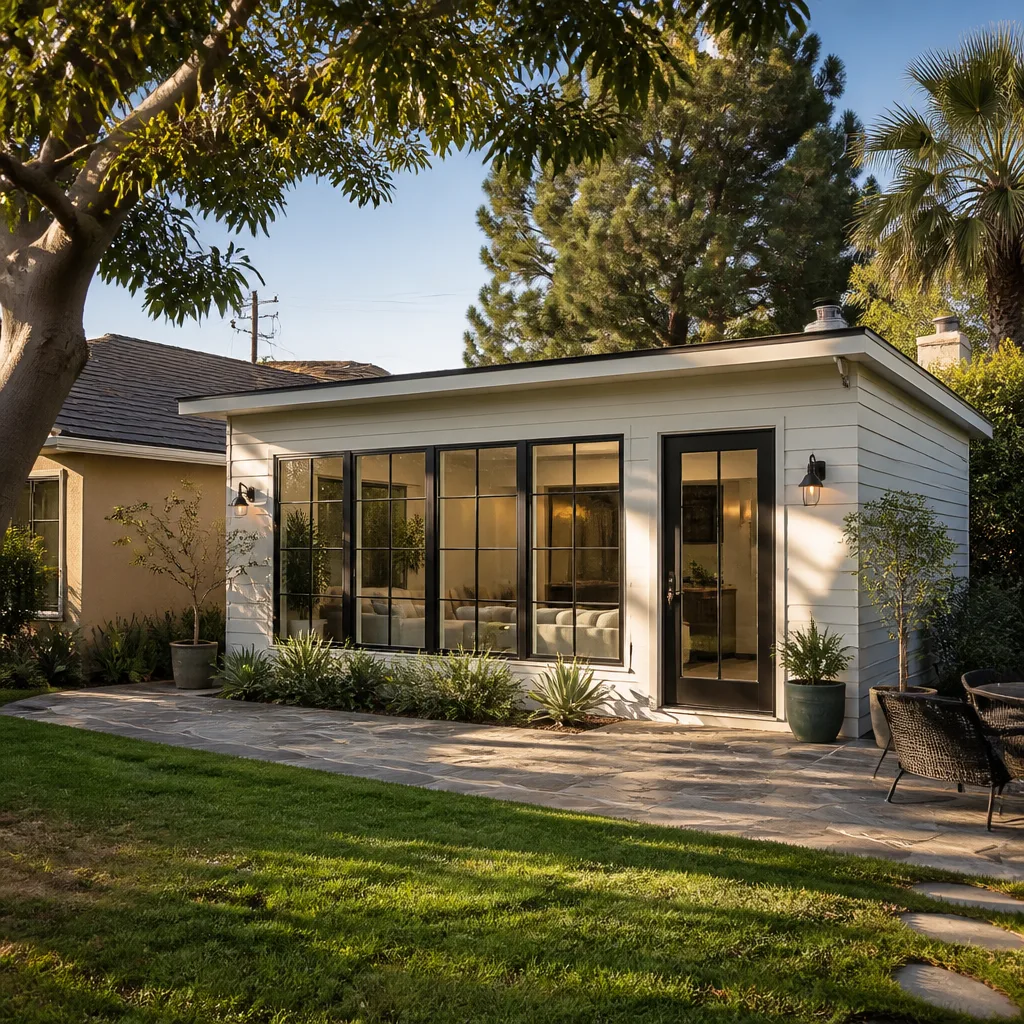
A 400 sq ft addition in Spring Valley typically runs $95,000 to $185,000 all-in, with permits, design, materials, and labor broken out separately in the written scope. The spread depends on materials, site conditions, and whether the addition shares a wall with the existing structure. Call (844) 780-4284 for an exact quote on your project. Estimates are free.
Yes. Any addition that adds square footage or changes the structure requires a Clark County Development Services permit, and the process begins with a pre-application meeting. Spring Valley is unincorporated Clark County, so the county issues the permit, not the city of Las Vegas. Skipping the county pathway is how stop-work orders happen.
Plan four to eight weeks for plan review after submittal, plus two to four weeks for the architectural drawings before that. Hot months slow exterior work, so a Spring Valley addition that starts in April usually finishes faster than one that starts in July.
It shouldn’t. A proper written price is fixed before work begins, and the only price changes should come from change orders you’ve approved in writing. At Lodgewick, every project begins with a written price and there are no price changes at the door. Ask every contractor you interview whether their bid is fixed in writing or an estimate that floats; the answer tells you which kind of contract you’re signing.
An ADU is a separate living space with its own entrance and kitchen; an addition extends the existing house. The two are governed by different Clark County code sections, which is why the set of allowable setbacks and lot-coverage rules differs between them. Our Garage Conversion Contractor in Spring Valley page covers how a garage conversion fits between the two.
No. You need to be reachable, and you should expect a defined arrival window and a clean job site every day. If you’re not on site, the written agreement is what protects you, and it should say clearly how the job site is handed back each evening. At Lodgewick, every project includes the Kingswell Way standard in writing: show up in the window given, leave the place cleaner than found, come back if anything fails within the guarantee.
The Bottom Line
Spring Valley’s addition pathway rewards homeowners who plan the county side first and the contractor side second. Get a licensed contractor who’s attended the pre-application meeting on other Spring Valley projects, verify the setbacks against the parcel, and demand a written scope with all four key clauses before you sign. Get three bids and compare them line by line, not by headline number. The cheapest bid is almost always the thinnest scope, and thinnest scope becomes the widest overrun. Start with a written price before any work begins, and keep the warranty commitment in writing. These are the parts that separate a smooth build from a stop-work order. For everything else, call and we’ll walk you through it.
Lodgewick ADU Builders Spring Valley works with homeowners across the valley on additions, ADUs, and garage conversions under The Kingswell Guarantee: a written price before work begins, a defined arrival window, a clean job site, and a written guarantee on every project. Our technicians have up to 16 years of experience, and our line is answered by a live person 24 hours a day. Call (844) 780-4284 for a free estimate.
Written by the team at Lodgewick ADU Builders Spring Valley.