Last updated November 18, 2026
Garage Conversion Contractor Warning Signs Every Homeowner Should Know
The most expensive garage conversion mistake isn’t hiring someone with no license. It’s hiring someone with a license who hands you a one-page “estimate” instead of a written scope, then uses change orders to double the price. We’ve seen this play out across Spring Valley more times than we’d like: a homeowner signs something that looks official, work starts, and three weeks later the number on the page has grown by $30,000 with no clear reason why. This guide walks through the specific contract omissions, permit behaviors, and day-one job-site signals that predict a bad outcome long before the drywall goes up. You’ll learn what to read, what to ask, and what to walk away from.
Quick Answer
The clearest warning signs of a bad garage conversion contractor are a one-page estimate with no written fixed scope, vague permit language like “we’ll handle it,” no debris or staging plan on day one, and a guarantee that says “we stand behind our work” without naming what’s covered or for how long. Any one of these is a reason to slow down. Two or more is a reason to walk.
Table of Contents
- The Estimate vs. the Written Scope: Why Only One Protects You
- What a Legitimate Permit Pull Looks Like Versus “Off the Books”
- Day-One Job-Site Signals That Predict the Whole Project
- How to Read a Guarantee Clause (Specific vs. Vague)
- The Change-Order Trap: Documented Scope Changes vs. Manufactured Ones
- Contract Language That Should Make You Nervous
- Why Spring Valley Conversions Get Targeted
- Questions That Separate Real Builders From Pretenders
The Estimate vs. the Written Scope: Why Only One Protects You
An estimate is a number. A written scope is a promise. That difference is the single most useful thing you can understand before you sign anything for a garage conversion in Spring Valley.
An estimate says “garage conversion: $68,000.” It might be delivered on a napkin, a text message, or a single-page PDF with a logo. It doesn’t say what’s included, what isn’t, or what happens if the number needs to move. When the contractor discovers the garage slab needs leveling or the electrical panel can’t handle the new load, that $68,000 quietly becomes $89,000, and you have no document to point to.
A written scope, by contrast, lists line items: demolition and haul-away, slab prep, framing, insulation R-value, drywall finish level, electrical rough-in, plumbing if applicable, HVAC approach, finish materials by brand or spec, and the permit pull. It names who’s responsible for what. It states the price against those line items and says explicitly whether the price is fixed or subject to change, and under what conditions.
When you’re comparing garage conversion contractors in Spring Valley, put the documents side by side. Ask each one: “Is this a fixed price, and if not, what specifically would trigger a change?” A contractor who can’t answer that in writing is telling you something.
- Estimate only: one number, no line items, no exclusions listed, no change-order process defined.
- Written scope: line-by-line pricing, named materials, explicit exclusions, defined change-order process, fixed-price statement.
- What you want: the second one, in writing, before a single nail is driven.
For a deeper look at how a real conversion scope comes together, see our guide to hiring a garage conversion contractor in Spring Valley.
What a Legitimate Permit Pull Looks Like Versus “Off the Books”
A legal garage conversion in Spring Valley involves a building permit, plan review, inspections at defined stages, and a certificate of occupancy or final sign-off. That paper trail is your protection. It’s also the thing shady contractors most want to avoid.
Here’s what a legitimate permit process actually looks like:
- Pull before demo. The permit is issued in the property owner’s name or the contractor’s, and you receive a copy with the permit number before work begins.
- Plans on file. Plans are submitted to the jurisdiction and stamped. You get a set.
- Scheduled inspections. Rough framing, electrical, plumbing, and insulation each get inspected at specific stages. You know when they’re happening.
- Final sign-off. The jurisdiction issues a final approval or certificate of occupancy. That document is what makes the new space legally habitable and insurable.
Now the warning signs. A contractor who says “we don’t need a permit for a garage conversion” is either wrong or lying. A contractor who says “we’ll handle the permits” but never shows you a permit number is hoping you won’t ask. A contractor who suggests doing the work “off the books” to save you money is handing you a future problem: an unpermitted conversion can derail a sale, block insurance claims, and force you to tear out finished work to get it inspected retroactively.
Ask directly: “Will you pull the permit, and will I get a copy of the number before work starts?” In Spring Valley, that question alone filters out a surprising number of bidders.
Day-One Job-Site Signals That Predict the Whole Project
You can often tell how the next three months will go within the first two hours. The crew’s behavior on day one is a preview, not a one-off.
Bad sign: the crew arrives without plans. If nobody on site has a set of drawings, nobody is building to the drawing. Expect decisions to be made on the fly, and expect those decisions to cost you.
Bad sign: no dumpster, no debris plan. A real garage conversion generates a lot of waste: old doors, concrete, framing offcuts, packaging. A crew with no staging plan is a crew that will pile debris in your driveway, your side yard, or the street, and leave it there. Ask where the dumpster goes and when it arrives. “We’ll figure it out” is an answer.
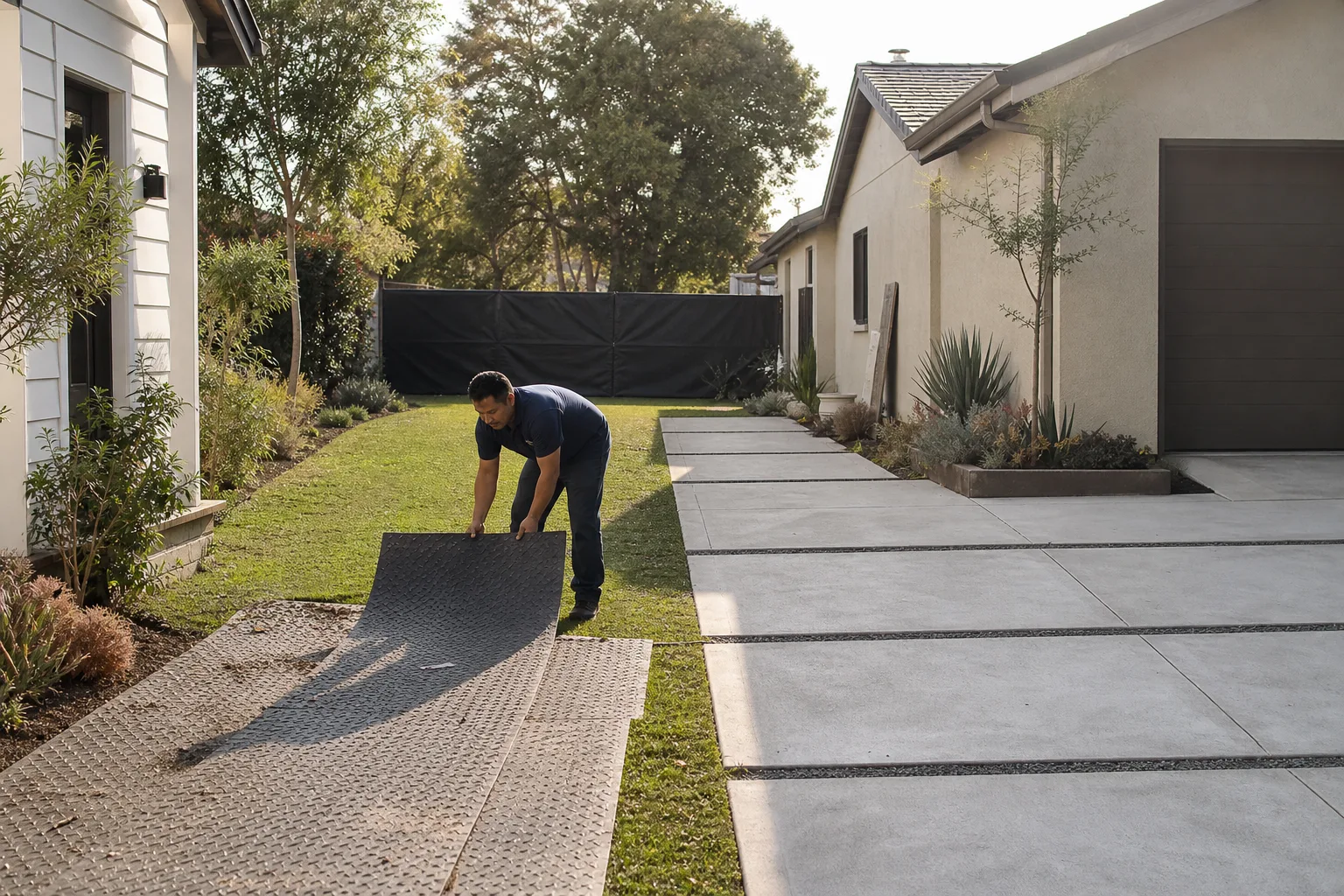
Bad sign: no protection for your home. Floors, adjacent walls, and landscaping should be protected before demo starts. Dust barriers go up before the first hammer swings.
Bad sign: nobody can tell you who’s in charge. A legitimate job has a lead on site who can answer questions and whose name you know. If every crew member shrugs when you ask who’s running the job, walk.
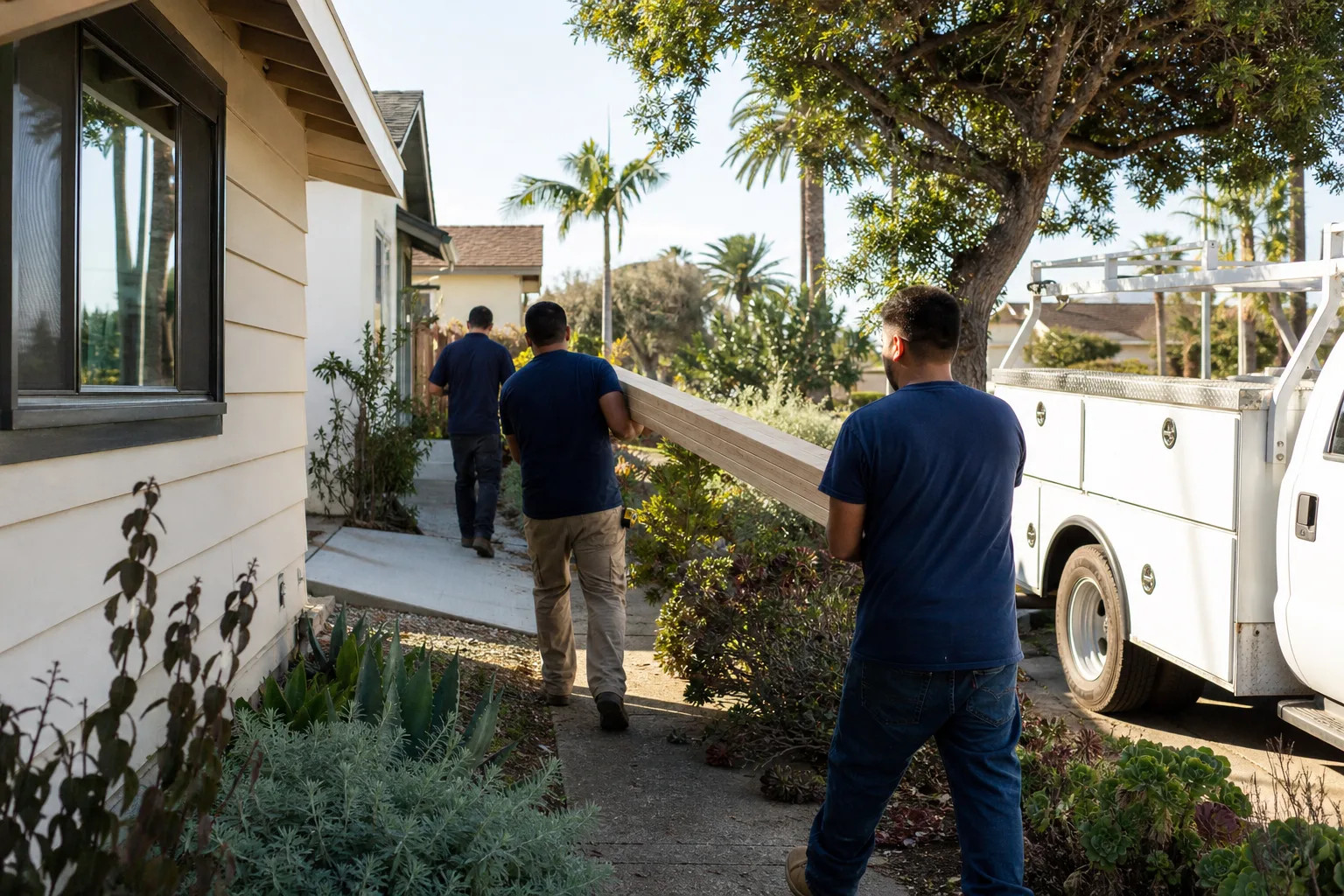
Good sign: the crew has the written scope on site, the plan set on site, and a defined arrival window they hit. That last one is a discipline signal. A crew that shows up in the window it gave you is a crew that will hit its inspection dates.
If the day-one signals are wrong, they rarely self-correct. Trust the pattern.
How to Read a Guarantee Clause (Specific vs. Vague)
“We stand behind our work” is not a guarantee. It’s a feeling. A real guarantee clause names what’s covered, for how long, and what happens if the work fails. Read it as a document, not a slogan.
Ask these questions of any guarantee clause you’re handed:
- What exactly is covered? Structural? Water intrusion? Electrical? Finish defects? All of it, or only the parts the contractor chooses?
- How long does coverage last? A number of days or years, stated plainly. “For the life of the home” with no definition is meaningless.
- What triggers a return visit? Does the clause say the contractor comes back if the work fails, or only if they decide it failed?
- Is there a cost? A guarantee that requires you to pay for the return visit isn’t really a guarantee.
- Is it in writing, on every project, before work starts? If it’s verbal, it doesn’t exist.
At Lodgewick ADU Builders Spring Valley, our written guarantee is the 365-Day Done Right Promise: if the work isn’t right, we come back and make it right, and that commitment is in writing on every project before work begins. We name the promise because we can point to it, not because it sounds good. When you’re comparing contractors, ask each one to hand you their guarantee clause. The ones who can produce one, with specifics, are the ones worth keeping on your list.
The Change-Order Trap: Documented Scope Changes vs. Manufactured Ones
Every real construction project has some scope changes. A wall you thought was empty turns out to hold plumbing. The city’s plan reviewer wants a different ventilation approach. These are legitimate, and a fair contract handles them cleanly.
Here’s the difference between a legitimate change order and a manufactured one:
Legitimate change order: You get a written document before the work happens. It describes the change, prices it as a line item, and you sign it. The original scope stays on file. The change gets added to the running total with your signature on file for each one.
Manufactured change order: The contractor tells you after the fact that something cost more. There’s no written document, no prior approval, no line-item price. The number just shows up on the invoice. Sometimes two or three of them at once, right before you’re asked for the next draw.
The classic Spring Valley version goes like this: the original “estimate” excludes “site prep,” “electrical upgrades,” and “permit fees.” Work starts, those items turn out to be necessary, and each one gets billed at whatever number the contractor chooses. The original $68,000 grows to $95,000, and every step of the way the contractor says “well, this had to be done.”
The defense is simple: require written, pre-approved change orders with line-item pricing before any work happens, and require the contractor to state in the original scope that items outside the scope will be priced the same way. A contractor who agrees to that in writing is telling you they run a clean job. A contractor who pushes back is telling you how they make their money.
Contract Language That Should Make You Nervous
The contract is where bad outcomes get baked in. You don’t need to be a lawyer to spot the phrases that should slow you down.
- “Payment due in full at signing” or large upfront draws. A big deposit before work starts puts you in a weak position. Standard practice ties payments to milestones: demo complete, rough-in inspected, drywall finished, final inspection passed.
- “Price subject to change without notice.” Language that lets the contractor move the number with no approval process removes your protection. Fair contracts define the change process.
- “Contractor not responsible for permits.” If the contractor ducks permit responsibility in writing, they’re setting up a conversion that may not legally count as habitable space.
- No start date and no completion estimate. A contract with no defined arrival window and no completion target is a contract the contractor can stretch indefinitely.
- No guarantee clause in the contract at all. If the guarantee only exists in conversation, it doesn’t exist.
- “Verbal changes accepted.” A contract that allows verbal changes opens the door to the change-order trap described above.
- No named materials or specs. “Quality materials” without a brand or spec lets the contractor substitute whatever costs least.
Read the whole contract before you sign. If something’s unclear, ask. A contractor who can’t explain their own contract in plain English is worth walking away from, no matter how good the price looks.
Why Spring Valley Conversions Get Targeted
Garage conversions are one of the most active categories of residential construction in Spring Valley right now, and that volume attracts both good builders and opportunists. The same demand that draws reputable contractors also draws the ones who show up for the deposit and disappear.
A few local realities shape the risk. Spring Valley’s heat is hard on materials and crews; insulation spec and HVAC sizing matter more here than they might in a milder climate, and a contractor who doesn’t account for that is a contractor who’ll cut corners on the shell. The region’s growth means a lot of homeowners are converting garages to get an office, a rental unit, or space for aging family, often on lots grandfathered into more permissive rules than newer subdivisions. That variation makes permit knowledge a real differentiator: a builder who knows the local plan-review process will pull cleanly; one who doesn’t will get stuck and pass the delay to you.
We work across Spring Valley on conversions of all sizes, and the pattern is consistent: the jobs that go wrong are the ones that started with the wrong document, not the wrong contractor personality. Charming contractors with bad paperwork lose homeowners more money than grumpy contractors with clean scopes. The paperwork is where the truth lives.
If you’re exploring a legal conversion or an ADU for the property, our team at ADU builders in Spring Valley can walk you through how the permit path and scope come together for your specific lot. Our Lodgewick ADU Builders Spring Valley home shares the full picture of how we work; our home addition contractor in Spring Valley guide covers the broader additions picture if your space needs grow beyond the garage.
Questions That Separate Real Builders From Pretenders
You don’t need to know construction to vet a garage conversion contractor in Spring Valley. You need a few sharp questions and the willingness to read the answers.
- “Can I see a written scope with line items before I sign anything?” If the answer is no, or if the scope arrives without prices, stop.
- “Will you pull the permit, and will I get the number before work starts?” Commitment to a permit number in writing filters out the off-the-books operators immediately.
- “What’s your change-order process, and can I see it in writing?” Look for pre-approval, line-item pricing, and a signature requirement.
- “What does your guarantee actually say, and can I see the clause?” Vague guarantees vanish. Written ones survive.
- “Who’s on site day one, and what’s the debris plan?” Answers here reveal a lot about operational discipline.
- “What’s included in the price, and what’s explicitly excluded?” The exclusions list matters as much as the inclusions.
- “How do I reach you during the build?” A contractor who can’t answer a phone during the job is a contractor who won’t answer one after the guarantee kicks in.
Ask all seven of every contractor you consider. Keep the written answers. Compare. The one who answers every question in writing, without hesitation, is the one worth your deposit.
Common Mistakes to Avoid
- Signing a one-page estimate and calling it a contract. It doesn’t define scope, so it doesn’t protect you when the number moves. Demand a written scope with line items before you sign anything.
- Accepting “we’ll handle the permits” without a permit number. Off-the-books work in Spring Valley can derail a future sale and block insurance claims. Require the permit number in writing before demo starts.
- Choosing the lowest bid without comparing scopes. A low bid usually means a narrower scope, not a better deal. Price the two documents line by line before deciding.
- Ignoring the change-order process until changes happen. By then, you’ve lost leverage. Define the process in the original contract, before the first change.
- Treating the guarantee as a slogan. “We stand behind our work” isn’t a guarantee. Insist on a written clause naming what’s covered and for how long.
- Skipping day-one observations. The crew arriving without plans, no debris plan, no protection for your home: those signals don’t self-correct. Catch them early.
- Paying large upfront deposits. Payments tied to milestones keep the project on schedule and keep you in control of the money.
When to Call a Professional
Some garage conversion decisions need a professional in the room, not a search engine. Call us when any of these fit: you’ve received two or three bids and the scopes don’t line up, so you can’t tell what you’re really comparing. You’ve been handed a contract with language you don’t like and want a second set of eyes on the scope before signing. Your current contractor has already started moving the number without written change orders. Or you’re early in the process, you own a Spring Valley property with a garage that could become an office, a rental, or a family suite, and you want the permit path and the real project range before you commit to anything.
Lodgewick ADU Builders Spring Valley offers free estimates in Spring Valley – call (844) 780-4284. Every project runs under The Kingswell Guarantee: a written price before work begins, a defined arrival window, a clean job site, and a written guarantee on every job. A live person answers the phone, day or night.
Frequently Asked Questions

The biggest warning sign is a one-page estimate with no written fixed scope. It gives the contractor room to add change orders after work starts, and it gives you no document to point to when the number moves. A written scope with line items, named materials, and a defined change-order process is the single document that best protects you.
Yes. A legal garage conversion requires a building permit, plan review, staged inspections, and final sign-off. Any contractor who tells you a conversion doesn’t need a permit is either misinformed or steering you toward unpermitted work. Ask for the permit number in writing before work begins; legitimate contractors will provide it without hesitation. Call (844) 780-4284 for an exact quote on your project – estimates are free.
A garage conversion in Spring Valley typically ranges from roughly $45,000 for a basic single-car office conversion up to $140,000 or more for a full ADU-grade conversion with a kitchenette and bath. The exact number depends on the shell condition, electrical capacity, HVAC approach, and finish level. Any contractor quoting a single lump sum without a written scope is skipping the work that produces a real number. Call (844) 780-4284 for a written scope and fixed price on your specific project.
A real guarantee names what’s covered, for how long, and what happens if the work fails. Vague language like “we stand behind our work” without a specific clause isn’t a guarantee. Ask for the clause in writing before you sign the main contract. Our 365-Day Done Right Promise is written into every project: if the work isn’t right, we come back and make it right, with no charge for the return visit.
A change order is a written adjustment to the original scope, usually required when site conditions or code requirements change the work. A legitimate change order is priced as a line item, documented in writing, and approved by you before the work happens. A manufactured change order shows up on the invoice without prior approval or line-item pricing. Require pre-approval in writing, every time.
You know by what they bring on day one and how they behave. A legitimate crew shows up in the window they promised, brings the plan set and the written scope, sets up debris and dust protection before demo, and has a named lead on site you can talk to. At Lodgewick, our technicians are background-checked and uniformed on every job site, so you always know who’s on your property.
The Bottom Line
The garage conversion contractors most likely to cost you money aren’t the ones who look sketchy from a mile away. They’re the ones with a license who hand you a one-page estimate, promise to “handle the permits,” and use change orders to move the price $30,000 after you’ve committed. Your defense is documentation: a written scope with line items, a permit number before work starts, a defined change-order process, and a guarantee clause that names what’s covered and for how long. Treat every project like a contract reading exercise, and the box of warnings in this guide will filter out the ones who’ll burn you. When you’re ready to compare with a written scope in hand, call (844) 780-4284 for a free estimate in Spring Valley.
Written by the team at Lodgewick ADU Builders Spring Valley.