Last updated November 18, 2026
How to Hire an ADU Contractor in Spring Valley: A Step-by-Step Guide
Of the contractors advertising ADU services across the Las Vegas metro, fewer than a third have actually pulled a standalone ADU permit in Clark County in the past 24 months. That’s not a guess or a knock on the trades. It’s sitting right there in the county permit database, public and searchable, and almost no homeowner ever looks before signing a five- or six-figure contract. Hiring an ADU contractor in Spring Valley is less about collecting three bids and picking the middle one and more about a single structured check you can run before the second phone call. This guide walks you through that sequence: the permit search, the three documents to demand, the line-item language to read for, and the payment schedule that tells you to walk away.
Quick Answer
To hire an ADU contractor in Spring Valley, verify their Clark County permit history for real accessory dwelling unit projects, then request three written documents before signing anything: a written scope, a written price, and a written guarantee. Compare bids only after translating each into the same line items, and be wary of lump-sum allowances, verbal timelines, and any contractor who asks you to pull your own permit.
Table of Contents
- Step 1: Check the Clark County Permit Database First
- Step 2: The Three Documents You Request Before the Second Call
- Step 3: Red Flags in an ADU Contractor’s Pitch
- Step 4: How to Compare Bids That Use Different Formats
- Step 5: What a Reasonable Payment Schedule Looks Like
- Step 6: Spring Valley Site Conditions That Change Your Build
- Step 7: What a Written Guarantee Should Actually Say
- Common Mistakes to Avoid
- When to Call a Professional
- Frequently Asked Questions
Step 1: Check the Clark County Permit Database First
Before you take a single sales call, spend twenty minutes in Clark County’s online permit portal. Every jurisdiction around Las Vegas publishes permit records, and any contractor doing real ADU work in Spring Valley is going to show up. The point isn’t to catch anyone in a lie. It’s to see a track record with your own eyes instead of taking it from a brochure.
Here’s how to run the search:
- Open the Clark County Building Department’s permit search portal and search by contractor license or business name, not by address. You want a list of their jobs, not one address you have to guess at.
- Filter the results by permit type. Accessory dwelling units, garage conversions, and second-dwelling units each carry their own classification. You want to see standalone ADU permits, not a stack of water-heater and reroof permits wearing an ADU hat.
- Check the dates and status. Look for projects that were actually permitted and inspected, ideally within the last 24 months. A permit pulled in 2019 and never closed out is not a track record; it’s an unfinished story.
- Note the scope on each permit. A garage conversion is a different animal from a detached two-story ADU. Make sure the permits you’re looking at match the project you’re planning.
- Look for final inspection sign-offs. A permit that passed a foundation inspection but never got finaled tells you something. Ask about it on the call.
In our experience around Spring Valley, the gap between who advertises ADU work and who has actually built one is wide. A roofer or general handyman can add “ADU” to a website in an afternoon. A closed-out ADU permit takes a year or more to earn. When you’re ready to talk to builders with a genuine local record, our ADU builders in Spring Valley page outlines what that work looks like from the inside.
Step 2: The Three Documents You Request Before the Second Call
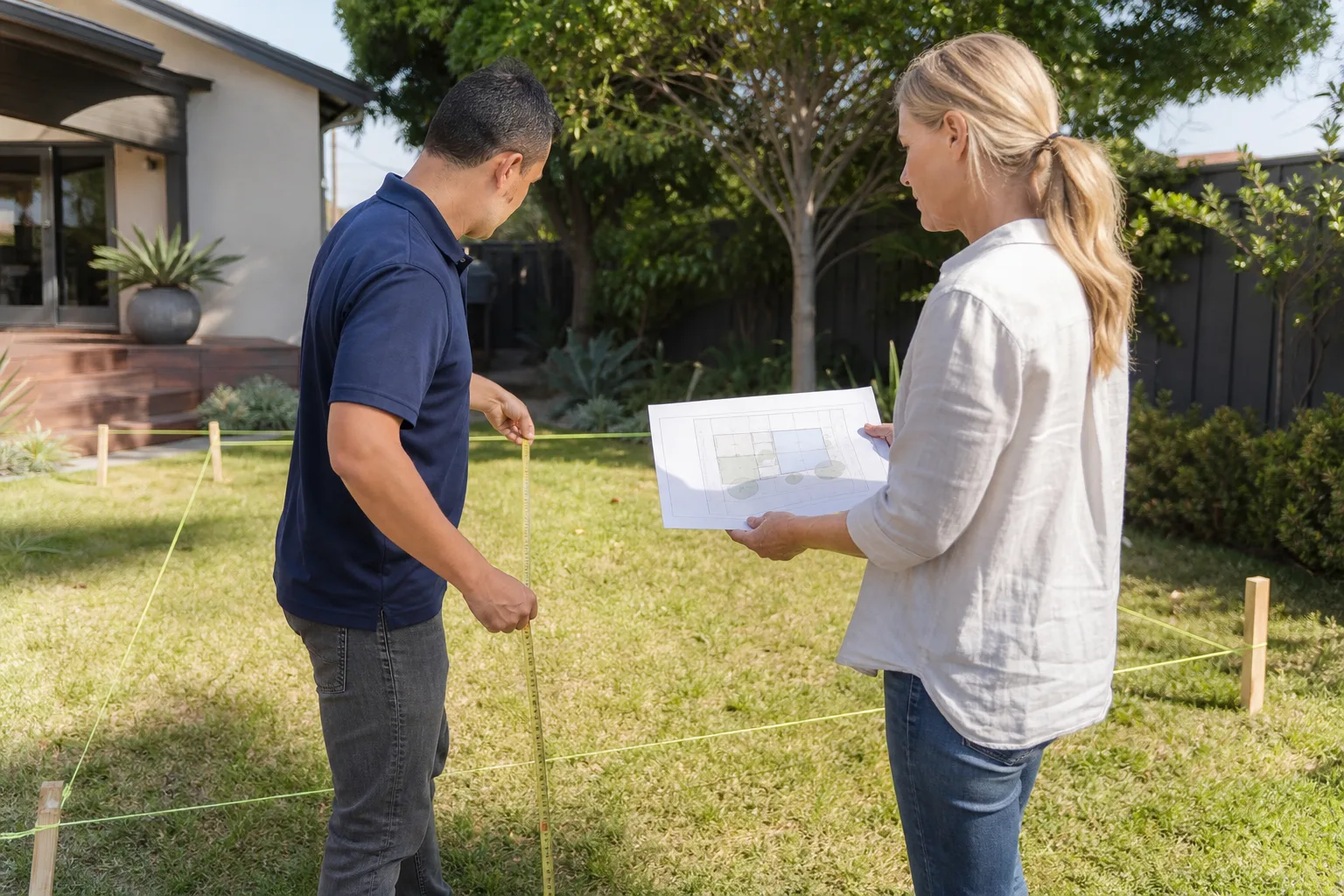
Any ADU builder worth your time can produce three documents without stalling. Ask for all three, and don’t schedule the second meeting until they show up. There’s no rush here, and a serious builder won’t flinch at the request.
1. A Written Scope
This is the plain-English list of what’s being built: square footage, number of rooms, foundation type, electrical service upgrade if needed, plumbing rough-in, finishes, appliances, and who pulls the permits. It should name the material brands where they matter, whether that’s James Hardie siding for the exterior or a prefab shell from Plant Prefab. If the scope is a single paragraph that says “turnkey ADU,” you don’t have a scope. You have a slogan.
2. A Written Price
A written price means a dollar figure tied to each line of the scope, not a range and not a ballpark. Allowances belong here too, but only with real numbers next to them. If the electrical line says “allowance” and nothing else, that’s a placeholder, and placeholders are where surprise invoices get born.
3. A Written Guarantee
This spells out what happens if something fails once the crew leaves. It should say what’s covered, for how long, and how a return visit gets scheduled. At Lodgewick ADU Builders Spring Valley, the 365-Day Done Right Promise means if the work isn’t right, we come back and make it right, and that commitment is written onto the project before work begins. Whether you build with us or someone else, insist the guarantee is on paper. A verbal guarantee is no guarantee.
Step 3: Red Flags in an ADU Contractor’s Pitch
Most bad ADU experiences in Spring Valley don’t start with an obvious crook. They start with a likable contractor and a set of soft phrases that leave the hard parts undefined. Here’s what to listen for.
- Vague allowances instead of numbers. If a bid reads “finishes: allowance” with no dollar figure, you’re being handed the bill in advance. Real bids name the number and the material.
- Verbal-only timelines. “About six months, give or take” is not a schedule. Ask for the timeline in writing along with the milestones attached to it. A defined arrival window on the day work begins matters as much as the month it ends.
- Asking you to pull your own permit. In Clark County, pulling a permit is the builder’s job, and it’s also how they put their name on the record as responsible for the work. A contractor who wants you to be the permit holder is shifting the liability onto your shoulders, and the inspections will reflect it.
- A price that “might move a little.” If the number changes once the crew is on site, it wasn’t a price. It was an opening bid. Ask them to put it in writing that the price won’t change mid-project, and see how they respond.
- No local permit history. If they can’t show you a closed ADU permit in Clark County, ask who’s actually building this and whether they’re subcontracting everything.
If any one of these shows up on the first call, don’t be embarrassed to press. A contractor confident in their work will welcome the question. One who gets defensive has just told you something useful.
Step 4: How to Compare Bids That Use Different Formats
Three bids land on your table, and they look like they were written in three different languages. One is a page of line items, one is a single lump sum, and one is an itemized mess. Comparing them by the bottom-line number is how homeowners overpay or under-build. Here’s how to translate them so you’re comparing the same scope.
- Align the scope first. Take the written scope from the builder you trust most and use it as a template. Whether you’re planning a detached unit or a garage conversion contractor in Spring Valley can deliver the same scope with a different build type, the line items should line up or the bids aren’t comparable.
- Break the lump sum. Ask the lump-sum bidder to itemize into these buckets: design and engineering, permits and impact fees, site work (grading, utility trenching, slab), shell and framing, electrical, plumbing, HVAC, interior finishes, exterior finishes, landscaping cleanup. Now you can line every bid up side by side.
- Watch for missing line items. One bid’s low number usually hides a missing bucket: no utility trenching, no grading, no final cleanup. Add the missing bucket at a reasonable market figure and see if the low bid is still low.
- Normalize the allowances. Two bids with different square footage of tile at different per-square-foot allowances are not the same bid. Pencil out each allowance to the actual finish budget you want and see whose number moves.
- Check what the permit line covers. Permits, inspections, and any Clark County impact fees should be spelled out. If one bid says “permits included” and another gives a dollar figure, dig until you understand why.
Once the buckets line up, the bids usually start to make sense. A $20,000 spread on a $150,000 ADU is almost always a scope difference, not a magic discount.
Step 5: What a Reasonable Payment Schedule Looks Like
For an ADU in the $100,000 to $200,000 range in the Las Vegas Valley, a healthy payment schedule ties each payment to a completed stage of work, not to a calendar date. Money follows progress. Here’s roughly what a fair schedule looks like.
- Deposit at contract signing: modest, covering design and permit work. Should be the smallest payment in the schedule, and it should unlock something real like finalized design and submitted permits.
- Foundation and slab complete: the first substantial payment, tied to an inspected foundation.
- Framing and rough-in complete: the payment tied to framing, electrical, plumbing, and HVAC rough-in inspections being passed.
- Dried-in and finish phase: a payment or two tied to insulation, drywall, and interior finishes.
- Final payment: a meaningful holdback released only after final inspection and a walkthrough with a written punch list.
A schedule that asks for 40% or more up front, before a permit is even pulled, should make you walk. A schedule that asks for the full balance before final inspection should make you walk faster. And a schedule where the contractor won’t accept a written retention at the end is a schedule built for their comfort, not yours.
Step 6: Spring Valley Site Conditions That Change Your Build
Spring Valley sits in the unincorporated pocket between Las Vegas and the Spring Mountains, and the site conditions here shape an ADU more than a generic brochure will admit. The soil and drainage are the first thing a real builder should be talking about. Caliche, the calcium-cemented layer that runs under a lot of Spring Valley lots, can push foundation costs up or force a different slab design. A builder who hasn’t worked in the area will find that out on day one and pass the change order to you. One who’s built here knows how to sample the soil and plan for it.
Summer heat is the second factor. An ADU here gets 110-degree stretches, so insulation, glazing choices, and HVAC sizing matter more than they do in a milder climate. We routinely see builds with undersized cooling systems or single-pane glazing that turn into $400 summer utility bills. Ask any builder what R-value they’re using in the attic and what glazing package they’re specifying. It’s a fair question and a fast filter.
Third is lot geometry. Many Spring Valley lots are wide but shallow, with an existing garage taking up the rear or side access. That geometry pushes a lot of local projects toward garage conversions rather than detached builds. If a detached unit doesn’t fit your lot, our garage conversion contractor in Spring Valley team can walk your lot and tell you what actually fits, permits and all. If you’re thinking bigger and adding square footage to the main house instead, our home addition contractor in Spring Valley page covers that path.
Step 7: What a Written Guarantee Should Actually Say
The last page of the packet is the one that pays off in year two. A real written guarantee names four things: what’s covered, how long it lasts, how a claim gets filed, and who actually shows up to fix it. If any of those four is missing, the guarantee is decoration.
At Lodgewick, we call our version The Kingswell Guarantee, and it pairs a written price before any work starts with a defined arrival window, a clean job site, and a written guarantee on every job, with a free return visit if the work fails inside the 365-day period. Our technicians have up to 16 years of experience, and the difference between a good build and a failed build is often how the crew handles the punch list after the last coat of paint. That’s why the guarantee sits in writing before work begins, not after something goes wrong. You can review how we approach the full build on our Lodgewick ADU Builders Spring Valley home page.
Common Mistakes to Avoid
- Picking the middle bid without checking scope. The middle bid isn’t automatically the safest. Translate all three bids into the same line items first, because the middle number may actually be the low number with the most missing pieces.
- Not searching the permit database. Skipping the Clark County permit search is the single most common mistake. It takes twenty minutes and it tells you more than an hour of sales conversation.
- Accepting a verbal timeline. “Spring Valley builds usually wrap in about six months” is not a schedule. You want dates and milestones on paper before the deposit clears.
- Letting the builder skip a permit. In Clark County, an ADU without a permit can create resale headaches and, in some cases, a forced demolition. A builder who suggests skipping the permit has just disqualified themselves.
- Paying too much up front. A 30% or 40% deposit before a permit exists is a red flag. Money should follow completed and inspected work, not precede it.
- Not asking about site conditions. Buyers here who don’t ask about caliche, drainage, or HVAC sizing end up fielding change orders they didn’t plan for.
- Treating the guarantee as an afterthought. The guarantee is the document that protects you in year two. If it isn’t in the packet on signing day, you’ve lost the leverage to ask for it later.
When to Call a Professional
Some ADU questions are worth an hour of research on your own. Others are worth a call the same day. If you’re staring at a permit database with no idea what you’re looking at, or you’ve got three bids with three different line-item formats and you need a neutral read, call a professional. Same if you’re exploring a garage conversion and want to know whether your existing structure can carry a second-story addition without a full rebuild, or if the contractor you’re considering has no closed ADU permits on record in Clark County and you’re not sure what that means. These are exactly the calls where a builder with a local track record can save you real money. Lodgewick ADU Builders Spring Valley offers free estimates in Spring Valley. Call (844) 780-4284 to schedule yours.
Frequently Asked Questions
Most ADUs in Spring Valley fall into one of three bands: a garage conversion typically runs $70,000 to $120,000, a small detached prefab unit from a brand like Abodu or Plant Prefab typically runs $110,000 to $180,000 installed, and a site-built detached unit or two-story design typically runs $150,000 to $250,000 depending on finish level and site work. Caliche and utility trenching can add cost on some lots. Call (844) 780-4284 for an exact quote, and estimates are free.
Search the Clark County Building Department’s online permit portal by the contractor’s license or business name, then filter the results by ADU or second-dwelling-unit permit type and check that the permits were issued and finaled within the last couple of years. Look for closed-out permits, not just open ones, and ask the builder to walk you through any that look unusual. A legitimate builder will do this without hesitation.
Yes. A garage conversion in Clark County requires a building permit and inspections for framing, electrical, plumbing, and HVAC, plus a separate review if you’re converting a permitted garage to habitable space. The permit also matters at resale, since an unpermitted conversion can create disclosure and financing issues later. Don’t let anyone talk you out of permitting the work.
It shouldn’t, if the scope and price are written out before work starts. Our written price is provided before any work begins, and any legitimate change should come only from a change order you sign in writing for an added feature or a discovered site condition. If a contractor’s price is verbal and open-ended, expect it to move. Ask for it in writing and see how they respond.
A proper written guarantee names what’s covered, how long it lasts, how a claim gets filed, and who shows up to make it right. Our 365-Day Done Right Promise covers the work for a full year, with a free return visit if something fails inside that window, and it’s in writing on every project. Insist on the same from any builder you hire.
A garage conversion usually takes 3 to 5 months from permit issuance, while a detached site-built ADU typically takes 6 to 10 months depending on design, engineering, and Clark County review timelines. Prefab units can compress the on-site portion but still require foundation work and utility connections. Get the timeline in writing with milestones before signing.
The Bottom Line
Hiring an ADU contractor in Spring Valley comes down to proof over promises. Search the Clark County permit database before the first sales call, request the written scope, written price, and written guarantee before the second, and compare bids on aligned line items rather than the bottom number. Run the numbers on caliche and site conditions, and walk from any payment schedule that puts 40% down before a permit exists. Do those four things and you’ll be choosing from real builders, not the ones who added two letters to their website last spring. If you’d rather start with a builder who puts all three documents in front of you from the first conversation, we’re ready when you are.
When you’re ready to get a real number in writing, call Lodgewick ADU Builders Spring Valley at (844) 780-4284 to schedule your free estimate. We’ll walk your lot, talk through what fits, and hand you a written price before any work starts.
Written by the team at Lodgewick ADU Builders Spring Valley.