Last updated November 18, 2026
The Complete Guide to ADU in Spring Valley
Most Spring Valley homeowners who start an ADU project don’t know that Clark County and any overlapping HOA can each kill your permit independently. That conflict alone is responsible for the majority of local ADU projects dying on the drawing board. The county says your lot is fine. The HOA says the second unit has to be invisible from the street. Neither side talks to the other, and you’re stuck in the middle holding a design fee and no building permit. This guide maps the actual path from idea to certificate of occupancy for Spring Valley parcels: the real setback and lot-coverage numbers, how to cross-check your CC&Rs, what each ADU type costs in 2026, and the inspection checklist that trips people up at the finish line.
Quick Answer
An ADU in Spring Valley is generally allowed under Nevada state law and Clark County zoning, but what you can actually build depends on three local filters: your parcel’s zoning and lot coverage, your HOA’s private restrictions, and whether your contractor pulls the permit in their own name. A detached ADU in Spring Valley typically runs $150,000 to $250,000, a garage conversion $80,000 to $140,000, and an attached addition somewhere in between, with permits and fees adding a few thousand on top. The projects that finish are the ones that reconcile the county and HOA rules before anyone draws a plan.
Table of Contents
- What counts as an ADU in Spring Valley?
- Which Clark County rules actually apply to Spring Valley parcels?
- How to cross-check your HOA CC&Rs against county allowances
- What does an ADU cost in Spring Valley in 2026?
- Detached ADU, attached addition, or garage conversion: which fits your lot?
- The permit and contractor verification steps that protect you
- The certificate of occupancy checklist
- Common mistakes to avoid
What counts as an ADU in Spring Valley?
An ADU, short for accessory dwelling unit, is a second home on the same lot as your main house. It has its own kitchen, bathroom, sleeping area, and entrance, so someone can live there independently. A JADU (junior accessory dwelling unit) is a smaller version carved out of the existing house, usually under 500 square feet, and it can share a bathroom with the main home. A garage conversion takes your existing garage and turns it into living space.
Spring Valley sits in unincorporated Clark County, which matters because you’re dealing with county zoning, not city of Las Vegas code. The neighborhoods here range from large-lot custom homes near the foothills to tighter tracts off Tropicana and Flamingo, and the parcel size you’re working with drives what’s buildable. State law has moved in the direction of allowing ADUs by right on single-family lots, but “allowed by state” and “approved on your specific parcel” are two different things. Your zoning designation, lot coverage limits, and any recorded deed restrictions all get a vote.
One naming note since it comes up: a lodge is a small house on a larger property. That’s exactly what an ADU is, which is part of why we do this work.
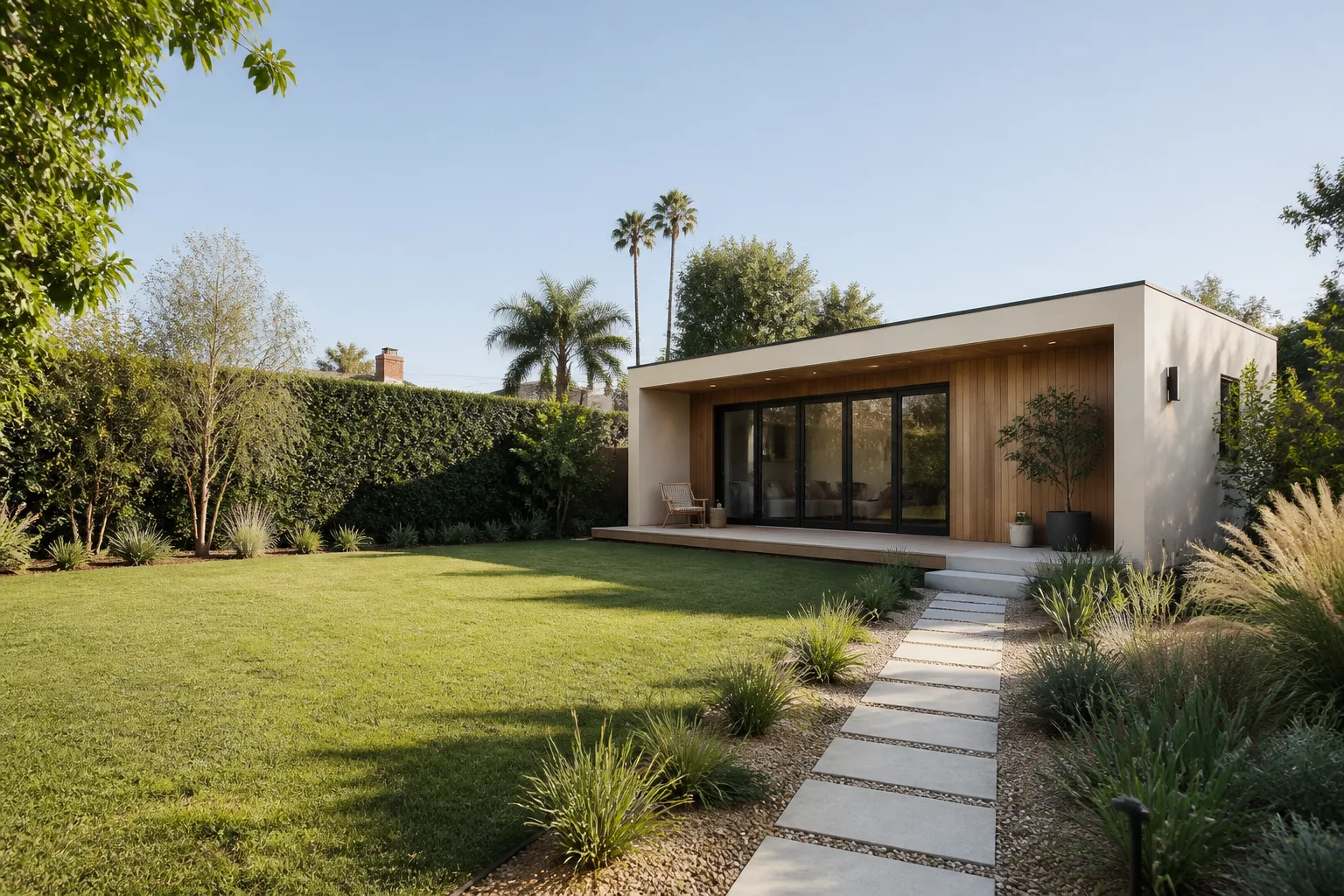
- Detached ADU: a separate structure in the backyard with its own address and utilities.
- Attached addition: new living space joined to the main house with its own entrance.
- Garage conversion: the cheapest path if you’re willing to give up parking.
- JADU: an interior carve-out, often the fastest to permit.
Which Clark County rules actually apply to Spring Valley parcels?
This is where the generic Nevada guides fall apart, because the numbers that matter are per-parcel. For a Spring Valley lot, you’re checking lot coverage (the share of the parcel that can be covered by structures), rear and side setbacks, height limits, and the parking question. County code generally treats an ADU as a subordinate use on a single-family lot, and the specific dimensional allowances depend on your zoning. Two houses on the same street can have different answers. A half-acre lot near a foothill community has room to work with; a 6,000-square-foot parcel in a mid-century tract has far less.
What we’ve seen repeatedly in Spring Valley: homeowners assume the state’s ADU allowance overrides local limits and design for square footage the parcel can’t support. The county then rejects the plan on lot coverage. Here’s the sequence that avoids that:
- Pull your parcel’s zoning and lot data from Clark County’s assessor and GIS records.
- Calculate your existing lot coverage (home, garage, patios, sheds) before proposing anything new.
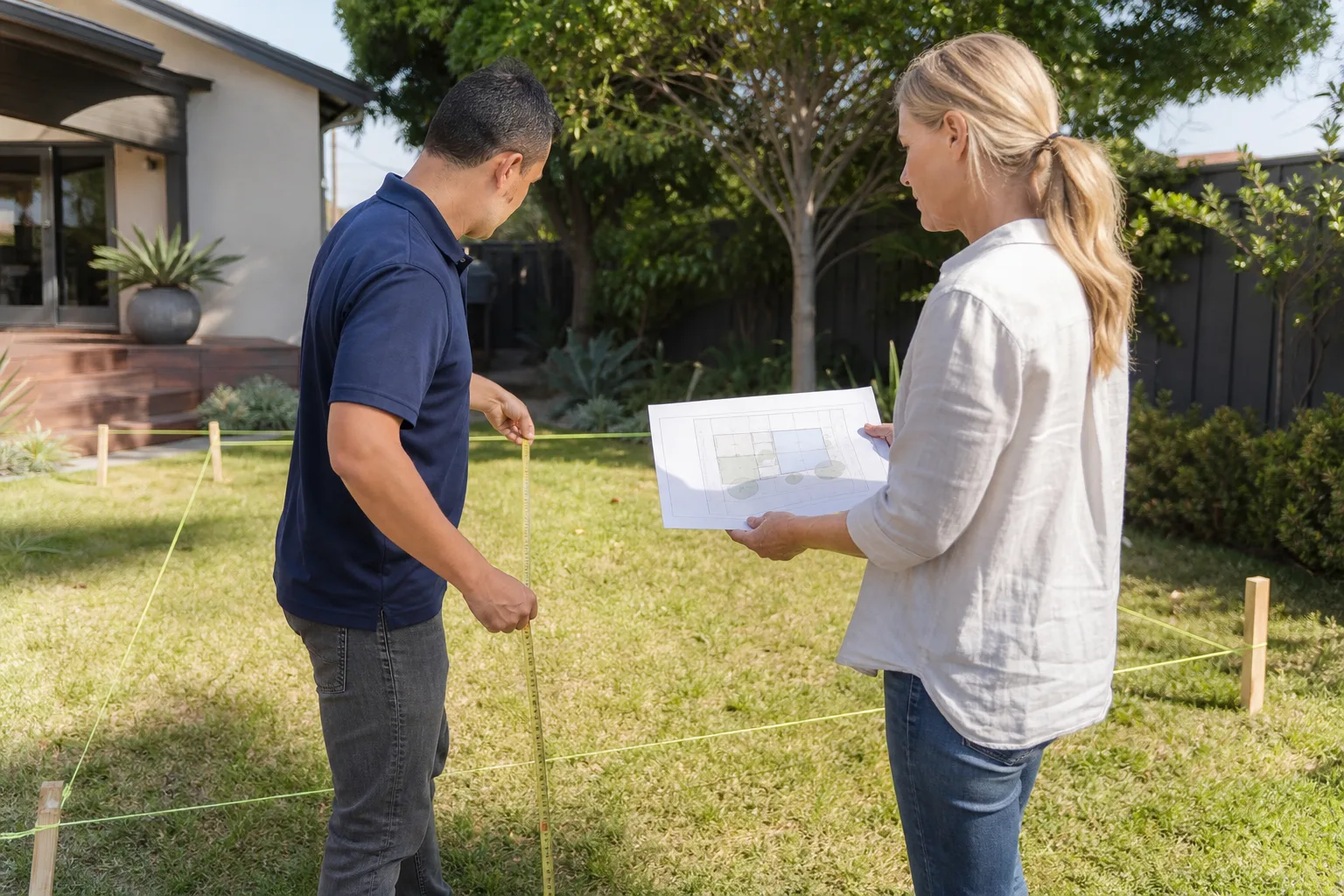
- Measure actual setbacks to the property lines, not the fence lines, which are often not where the lot line actually sits.
- Confirm height and parking allowances for your specific zoning district.
- Check for recorded restrictions on your title that limit second units.
Climate plays a role too. The desert heat and summer monsoon wind here punish flat roofs and cheap materials, and ADUs that sit in full western sun need real insulation values and proper roof overhangs. If a plan looks cheap on paper because it skipped those, the cooling bill will find you in July.
How to cross-check your HOA CC&Rs against county allowances
An HOA can restrict what the county permits. That’s the whole point of this section. Your CC&Rs (covenants, conditions, and restrictions) are private rules attached to your deed, and they often say things the county code says nothing about: no second structures, no rentals, guest houses only for non-paying family, minimum square footage on any dwelling, even architectural review by a committee. A county permit does not override your HOA, and an HOA approval does not satisfy the county.
Spring Valley is a patchwork of HOAs. Some subdivision parcels have active associations with architectural review; others have older, lapsed or unenforced restrictions still on the books. In our experience the projects that die are the ones that discover the restriction after the design is paid for. Do this first:
- Request the current CC&Rs and any architectural guidelines from your HOA (or the management company) in writing.
- Search the document for the words “accessory,” “second dwelling,” “guest house,” “garage,” and “rental.”
- Ask the HOA’s architectural committee whether an ADU requires their approval and what the review timeline is.
- Get the HOA’s answer in writing before you talk to a designer.
- If restrictions conflict with county allowances, the tighter rule wins, unless the restriction is legally unenforceable. That’s a question for a Nevada real estate attorney, not a contractor.
Reconciling HOA and county rules before design is the single biggest time saver available to a Spring Valley homeowner. Understanding this two-approval system before you draw is worth months of back-and-forth.
What does an ADU cost in Spring Valley in 2026?
For 2026, expect a detached ADU in Spring Valley to run roughly $150,000 to $250,000 depending on size, site work, and finishes. A garage conversion typically lands between $80,000 and $140,000. An attached addition tends to fall between the two, governed by how much foundation and roofline work is involved. These are real ranges, and any contractor who won’t put a number in writing before work starts is telling you something about how the project will go.
Here’s how the money breaks down across the main categories:
- Labor: roughly 40 to 50 percent of the total. Site prep, framing, MEP rough-in, finish work, and inspections all live here.
- Materials: roughly 30 to 40 percent. Foundation and concrete, framing lumber, windows, roofing, siding, insulation, kitchen and bath finishes.
- Permits and fees: a few thousand dollars for the building permit, plan review, and utility connections, plus any school or impact fees if they apply to your parcel.
- Design and engineering: civil, structural, and energy compliance documents, typically a few thousand to low five figures.
- Site-specific extras: grading, utility trenching, and any HOA-driven design changes that add cost.
Prefab and panelized options move these numbers. Working with manufacturers like Dvele, Mighty Buildings, and Plant Prefab, we can match a factory-built shell to a Spring Valley lot and often reduce on-site construction time, though site work, foundation, and utility connections still drive real cost. The written price is what matters: a number on paper before the first nail goes in, with no changes at the door. Our ADU builders in Spring Valley page walks through each type in more detail.
Detached ADU, attached addition, or garage conversion: which fits your lot?
The right type for your Spring Valley parcel comes down to three questions: how much lot coverage you have left, whether the site can handle a separate structure with its own utilities, and whether you can live without the garage. Detached ADUs give the most privacy and rental flexibility but cost the most and need the most site work. Attached additions work well on tighter lots where a freestanding structure won’t clear setbacks. Garage conversions are the value play: the shell and slab already exist, the utilities are usually close, and the square footage is already under roof.
For homeowners whose plans lean toward new living space rather than a full second unit, a home addition contractor in Spring Valley can weigh whether the addition should be designed as a full ADU from the start. It costs little more to make an addition ADU-legal than to build space you can’t rent or house family in later. If you’re leaning toward the garage path, the garage conversion contractor in Spring Valley page covers the utility, insulation, and egress details that make the conversion pass inspection. And if you’re starting from scratch on the whole concept, our Lodgewick ADU Builders Spring Valley home page is the place to begin.
The permit and contractor verification steps that protect you
The contractor who pulls the permit in their own name is the one who owns the project’s outcome. If a contractor asks you to pull the permit as the homeowner, that’s a red flag, because it puts the liability for code compliance on you. On a Spring Valley ADU, the builder should be the permit applicant, the one who schedules inspections, and the one who answers the correction notices. Pulling the permit yourself can also complicate insurance and future resale.
Nevada makes this easy to verify. Here’s the check:
- Search the Nevada State Contractors Board database for the contractor’s license number and confirm it’s active and in the right classification.
- Confirm the license is in the company’s name, not a subcontractor’s, and ask who will pull your permit.
- Ask for a written scope and price before any work starts. Ours is in writing on every project, no exceptions.
- Confirm the guarantee in writing: the 365-Day Done Right Promise means if the work isn’t right, we come back and make it right, and that commitment is in writing on every project.
- Confirm who’s on site: background-checked technicians, not a rotating cast of strangers.
If something goes wrong, the guarantee matters more than the bid. A written return visit is the difference between a fixed problem and a second contractor.
The certificate of occupancy checklist
A certificate of occupancy (CO) is the county’s final sign-off that the unit is safe to live in. Without it, the ADU isn’t a legal dwelling. The County inspections along the way cover framing, electrical, plumbing, mechanical, insulation and energy, and a final. A failed final inspection costs real time, because corrections mean rework, a reinspection fee, and another scheduling cycle. In our experience, most failed finals trace to a handful of recurring items that could have been caught before the drywall went up.
The checklist for a Spring Valley ADU final:
- Egress: every sleeping room has a code-compliant window or door, sized and opening per code.
- Smoke and CO alarms: interconnected, in the right locations, and functioning at inspection.
- Electrical rough-in and panel: signed off, labeled, and grounded, with the panel clearances met.
- Plumbing: fixtures installed, water heater strapped and vented, drains tested.
- Energy compliance: insulation values and window ratings matching the submitted documentation.
- Site and drainage: grading pitched away from the structure, utilities trench-signed and buried to depth.
- Final address and utility connections: the unit has its own address where required and separate metering if the plan calls for it.
A deficiency notice adds weeks to months depending on what’s wrong and how far back the rework goes. The way to avoid it is a builder who inspects his own work against the county checklist long before the county does.
Common Mistakes to Avoid
- Designing before checking your CC&Rs. A paid design doesn’t help if your HOA’s architectural committee says no second unit. Pull the rules first.
- Assuming state law overrides local zoning. State allowances don’t erase Clark County lot-coverage limits. Your parcel’s numbers decide.
- Letting the homeowner pull the permit. The moment you sign as permit applicant, code compliance lands on you, not the builder.
- Skipping the Nevada State Contractors Board check. A licensed, active, correctly classified contractor is verifiable in minutes. Do it.
- Choosing the cheapest bid without a written scope. A low number without a line-item scope is where change orders hide.
- Ignoring the desert climate in material selection. West-facing walls and low-slope roofs need real insulation and proper overhangs in Spring Valley, or summer cooling costs eat the savings.
- Forgetting the final inspection checklist until the end. Egress, alarms, and energy compliance are cheap to fix during rough-in and expensive after drywall.
When to Call a Professional
Call a professional when you’re ready to move from research to a real number. That means you’ve pulled your parcel data, you’ve read your CC&Rs, and you want someone to tell you what’s actually buildable on your Spring Valley lot. Also call before you buy a prefab shell on impulse, before you sign a design contract with a firm that hasn’t confirmed your HOA will approve, and before you accept a bid without a written scope. Our technicians have up to 16 years of experience with ADUs, garage conversions, and additions, and we work with established manufacturers like Dvele, Mighty Buildings, and Plant Prefab to match a build to your lot and budget. Lodgewick ADU Builders Spring Valley offers free estimates in Spring Valley, and a live person answers the phone around the clock: call (844) 780-4284.
Frequently Asked Questions
Usually yes, but only if your specific parcel passes three checks: your Clark County zoning and lot coverage allow it, your HOA’s CC&Rs don’t prohibit it, and your builder pulls the permit in their own name. Any one of those can stop a project even when the other two are fine. Call (844) 780-4284 for a free estimate and a parcel-level answer.
Detached ADUs run roughly $150,000 to $250,000, attached additions fall in between, and garage conversions typically land at $80,000 to $140,000, with permits and fees adding a few thousand. Labor is the largest share, then materials and permit costs. Get a written line-item price before any work starts. Call (844) 780-4284 for an exact quote – estimates are free.
Yes, if your parcel is in an active HOA with architectural review. County approval does not override private CC&Rs, and the HOA’s restrictions can be tighter than county code. Request the current CC&Rs in writing and get the architectural committee’s answer in writing before you spend on design.
Not with us. We provide the written price before any work starts, every time, and there are no price changes at the door. That commitment and the 365-Day Done Right Promise are in writing on every project, with a free return visit if the work fails within the guarantee period.
The contractor should pull it in their own name. If you’re asked to pull the permit yourself, the liability for code compliance shifts to you and can complicate insurance and resale. Verify the contractor in the Nevada State Contractors Board database before signing, and ask who will be the permit applicant.
Most projects take several months from design through certificate of occupancy, and the biggest variable is how fast the HOA and county reviews move. Reconciling HOA rules against county allowances before design typically saves four to six months of wasted back-and-forth. Call (844) 780-4284 to talk through the timeline for your lot.
The Bottom Line
The ADU reality in Spring Valley comes down to three filters and one discipline. The filters: your parcel’s Clark County zoning and lot coverage, your HOA’s CC&Rs, and which contractor pulls the permit in their own name. The discipline: reconcile the first two before you pay for a design, because that’s where most projects die. Get a real number in writing for your lot, whether that’s a garage conversion at $80,000 to $140,000 or a detached ADU at $150,000 to $250,000, and confirm the guarantee is written down. Those four steps separate the projects that reach certificate of occupancy from the plans that never leave the drawing board.
Get Your Free Estimate
If you’ve read this far, you’re past the research stage and ready for a real number. Call (844) 780-4284 to schedule your free estimate with Lodgewick ADU Builders Spring Valley. We’ll review your parcel data, confirm what your zoning and lot coverage allow, walk through your CC&R questions, and give you a written line-item price before any work starts, backed by the 365-Day Done Right Promise. A live person answers, day or night.
Written by the team at Lodgewick ADU Builders Spring Valley.